
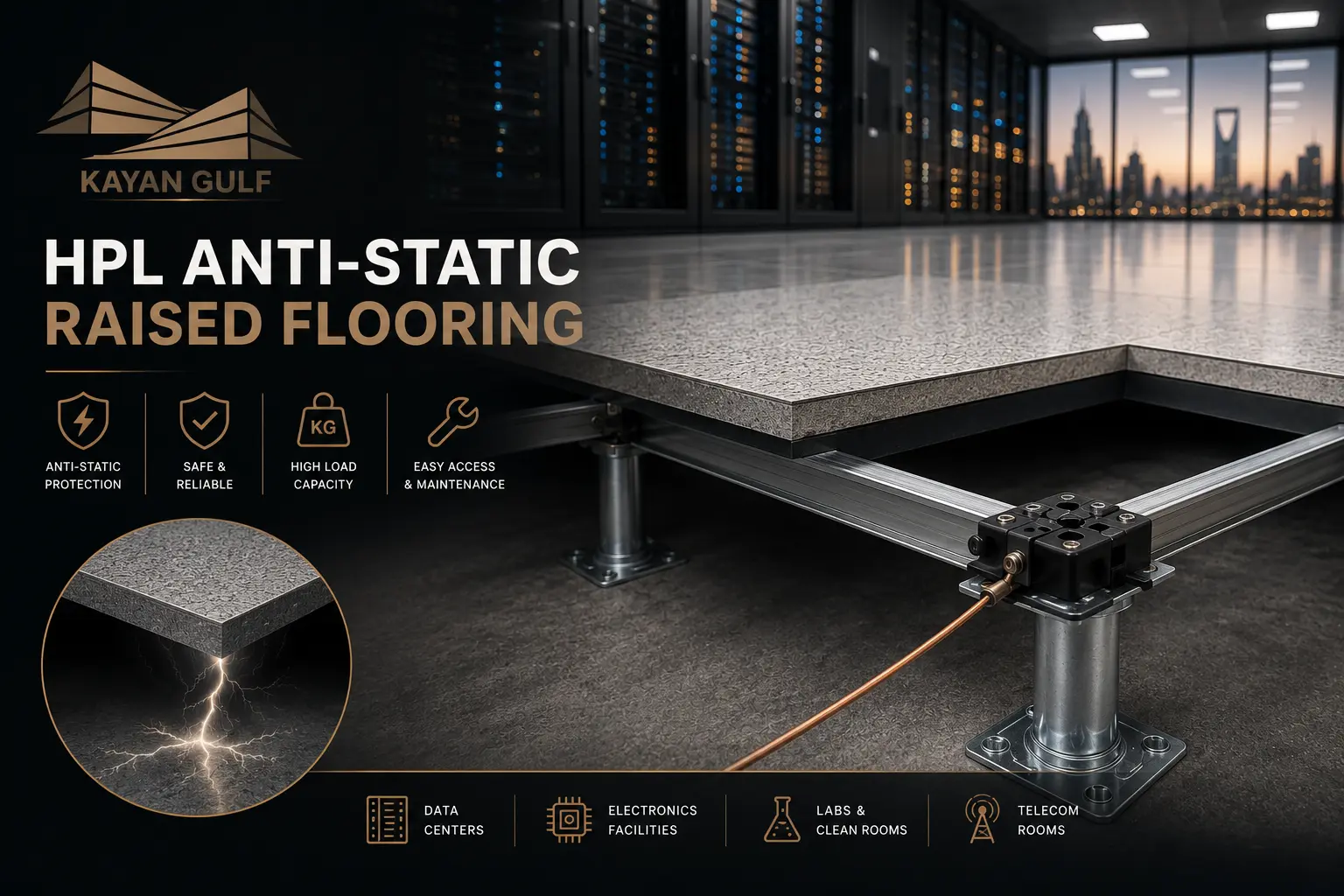
HPL anti-static raised flooring is a technical access-floor system that combines removable raised floor panels with a High Pressure Laminate surface intended for applications requiring durable flooring, underfloor service access and controlled electrostatic behaviour.
In the steel cementitious systems commonly used in computer rooms, data centers and control rooms, the HPL itself is the surface finish rather than the structural core. Beneath it is a rigid raised-floor panel supported on adjustable pedestals and, where specified, horizontal stringers.
A typical HPL anti-static raised access floor consists of an HPL surface, structural raised-floor panel, adjustable pedestal understructure and optional/stringered support grid. It is commonly selected for data centers, server rooms, computer rooms, control rooms and other technical areas where service accessibility and electrostatic-control requirements are important.
What Is HPL Anti-Static Raised Flooring?
HPL anti-static raised flooring is a modular access-floor system with a High Pressure Laminate surface selected for technical environments requiring removable floor panels and some form of controlled electrostatic performance.
A complete system normally includes several different layers and components rather than one single “anti-static tile.”
What Does HPL Mean in Raised Flooring?
HPL stands for High Pressure Laminate.
In this raised-floor context, HPL is generally the visible surface bonded to the top of the structural floor panel. It should therefore not be confused with the structural core of the raised floor.
A product can be described as an “HPL raised floor” even though the structural panel beneath that finish may be:
- steel cementitious;
- woodcore;
- calcium sulphate; or
- another manufacturer-approved construction.
For example, Huateng’s anti-static HPL system uses cold-rolled steel panels filled with cementitious material and finished with HPL on the top surface.
Specification rule: do not specify only “HPL raised flooring.” A proper specification should identify the panel construction, finish, load class, dimensions, understructure, floor height and required electrostatic performance.
How Is a Steel HPL Raised Access Floor Constructed?
Huateng’s steel anti-static access-floor family provides a useful example of typical construction.
The manufacturer describes the panels as being formed from cold-rolled steel sheets with cementitious filling. The HPL surface is bonded to the top, while the complete floor is supported by adjustable pedestals and stringers.
HPL Finish
Provides the visible technical walking surface and is selected according to project finish and electrostatic requirements.
Steel Panel
Formed steel construction provides the primary structural shell of the panel.
Cementitious Fill
The internal structural cementitious composite contributes to panel rigidity, mass and acoustic behaviour.
Adjustable Pedestals
Vertical supports establish the specified finished floor level.
Stringers
Horizontal members connect pedestal heads on systems designed to use a stringered understructure.
Accessible Void
The elevated floor creates space for cables, wiring, electrical distribution and other approved building services.
What Does “Anti-Static” Mean in Raised Flooring?
Static electricity is generated when electrical charge accumulates on people, materials or equipment. In environments containing sensitive electronic systems, unwanted electrostatic discharge can become an operational concern.
An anti-static raised floor is therefore designed as part of a system intended to control the accumulation and dissipation of electrostatic charge.
The important word is system.
Electrostatic behaviour can depend on:
- the HPL surface;
- panel construction;
- panel-to-panel interfaces;
- pedestal and stringer arrangement;
- grounding/bonding;
- installation method;
- environmental conditions;
- maintenance; and
- the actual project ESD specification.
Different projects may require different resistance ranges, grounding arrangements and test methods. Always obtain the exact manufacturer test report or approved technical submittal for the proposed floor rather than assuming all products labelled “anti-static” perform identically.
Anti-Static, Static-Dissipative and Conductive: Are They the Same?
These terms are often used casually in flooring discussions, but they should not automatically be treated as synonyms in a technical specification.
Projects involving ESD-sensitive equipment should define the actual required electrical performance instead of selecting a floor from a product name alone.
| Term | How to Treat It During Procurement |
|---|---|
| Anti-Static | Broad description indicating that static-control performance is intended. Verify the actual tested values and method. |
| Static-Dissipative | Should be tied to a specified electrical-resistance range and applicable test requirement. |
| Conductive | Represents a different electrical-performance category and should be verified against the project specification. |
| ESD Flooring | General project terminology that still requires measurable electrical criteria and grounding/bonding requirements. |
Does an Anti-Static Raised Floor Need Grounding?
Where the raised floor forms part of the project’s electrical or electrostatic-control strategy, grounding and bonding should be coordinated with the electrical design.
The HT FS800 manufacturer specification specifically states that the electrical contractor is responsible for providing the necessary materials and labour to electrically connect the access floor to the building earth.
This is an important distinction: installing an HPL panel on a pedestal does not by itself prove that the completed floor satisfies the project’s grounding requirement.
A Complete ESD Approach
Depending on the project specification, the technical review can involve:
- specified HPL or other ESD surface;
- electrically compatible panel construction;
- pedestal/stringer continuity where relevant;
- grounding/bonding to building earth;
- approved connection details;
- post-installation testing where specified; and
- maintenance procedures that preserve intended electrical behaviour.
HPL vs Conductive PVC Raised Flooring
Huateng supplies both HPL-finished and conductive-PVC raised-floor systems. They can share a similar steel cementitious panel construction while using different top surfaces.
Anti-Static HPL
Hard laminate technical surface commonly used in computer rooms, control rooms, data centers and similar environments.
- hard modular surface;
- durable technical finish;
- easy panel identification and replacement;
- multiple visual finish options depending on manufacturer;
- electrical performance must be verified.
Conductive PVC
Conductive vinyl/PVC surface intended for applications where specifically defined conductive behaviour is required.
- smooth technical surface;
- conductive product options;
- used in electronics and laboratory environments;
- different maintenance characteristics;
- electrical resistance and grounding still require verification.
The decision should not be reduced to “HPL is better” or “PVC is better.” Select the finish according to the approved ESD criteria, application, wear requirements, cleaning regime, appearance and manufacturer technical data.
Where Is HPL Anti-Static Raised Flooring Used?
HPL anti-static access flooring is particularly relevant where technical equipment and underfloor services must coexist with a durable removable floor surface.
Data Centers
Accessible power/data infrastructure, technical equipment and project-specific ESD requirements.
Server Rooms
Cable management, equipment access and modular service routing.
Computer Rooms
One of the traditional applications for HPL anti-static access flooring.
Control Rooms
Suitable technical platform for consoles, monitoring equipment and concealed infrastructure.
Telecom Facilities
Supports accessible power and communication infrastructure.
Technical Laboratories
Can be considered where the selected ESD and structural performance satisfies the laboratory specification.
HPL Anti-Static Raised Flooring for Data Centers
Data centers are one of the most commercially important applications for this type of floor.
A suitable HPL access-floor system can help provide:
- removable access to power and data services;
- organized cable infrastructure;
- support for technical equipment loads;
- integration with airflow panels where the cooling design requires them;
- modular replacement of individual floor panels;
- future service modifications; and
- an ESD-control surface where correctly specified.
Does Every Data Center Need an Anti-Static Raised Floor?
No. Modern data-center designs vary considerably.
Some facilities use raised floors extensively for cabling and airflow, while others use overhead distribution or different cooling/infrastructure arrangements.
The raised floor should therefore be selected from the actual mechanical, electrical, structural, ESD and operational design of the facility.
Featured System: HT FS800 HPL Raised Access Floor
The HT FS800 HPL system is particularly important within Kayan Gulf’s raised-floor offering because detailed manufacturer technical documentation is available for this exact configuration.
The system combines an HPL-finished steel cementitious panel with the HT FS-B-PST stringered understructure. Huateng describes it for computer rooms, equipment rooms and data centers requiring underfloor routes for mechanical services, cables, wiring and electrical distribution.
| Manufacturer | Changzhou Huateng Access Floor Co., Ltd. |
|---|---|
| Panel Type | HT FS800 HPL Access Floor |
| Understructure | HT FS-B-PST stringered understructure |
| Panel Size | 600 × 600 × 35 mm |
| Surface Finish | High Pressure Laminate (HPL) |
| Concentrated Design Load | 800 lb / 3.56 kN |
| Uniform Load Test | 4,000 lb/m² / 17.78 kN/m² |
| Ultimate Load | 2,530 lb / 11.25 kN |
| 10-Pass Rolling Load | 2.94 kN |
| 10K-Pass Rolling Load | 2.45 kN |
| Drop Impact | 100 lb / 45 kg from 36 in / 914 mm |
| Pedestal Axial Test | 10,000 lb / 44,800 N per pedestal |
These technical values belong specifically to the documented FS800 configuration. They should not be applied to every HPL raised floor or every system supplied by Kayan Gulf.
How Much Load Can an HPL Raised Floor Carry?
HPL itself does not determine the structural load capacity, and this applies equally to HPL raised floor tiles used as the surface finish on a steel cementitious panel system.
Load performance depends primarily on the complete raised-floor system, including:
- steel panel construction;
- panel internal geometry;
- cementitious fill;
- panel thickness;
- pedestal system;
- stringers;
- floor height;
- cutouts; and
- manufacturer test methodology.
Therefore, specifying “HPL raised floor” is not enough to establish whether the system can support a server cabinet, UPS unit or control console.
For a detailed explanation, read Kayan Gulf’s technical guide to raised floor load capacity .
What Understructure Is Used with HPL Raised Flooring?
HPL technical floors can use adjustable steel pedestals and, on applicable systems, horizontal stringers.
The HT FS800 manufacturer documentation specifically identifies the HT FS-B-PST stringered understructure.
Available Huateng understructure options documented for this system include:
- flat-head pedestal with stringer;
- snap-on pedestal with stringer;
- heavy-duty pedestal with stringer;
- high-floor configurations; and
- seismic/braced pedestal systems where specifically engineered.
Learn more in our raised floor pedestals, stringers and understructure guide .
What Height Should an HPL Raised Floor Be?
There is no universal HPL raised-floor height.
Finished Floor Height should be selected according to:
- power distribution;
- data cabling;
- cable trays;
- floor boxes;
- mechanical services;
- airflow requirements;
- equipment interfaces;
- door levels;
- ramps;
- maintenance access; and
- approved pedestal system.
The HT FS800 specification states that finished floor height should follow the project contract drawings.
Can HPL Raised Floor Panels Be Removed and Reinstalled?
Yes—accessibility is one of the principal purposes of a raised access floor.
The HT FS800 technical specification states that whole panels should remain interchangeable so future changes can be made and runs of panels can be removed for normal underfloor access.
This can simplify:
- cable additions;
- network modifications;
- electrical maintenance;
- floor-box relocation;
- equipment-layout changes;
- underfloor inspection; and
- replacement of individual damaged panels.
Advantages of HPL Anti-Static Raised Flooring
Durable Technical Surface
HPL provides a hard finished surface suitable for many computer-room and technical-floor environments.
Underfloor Accessibility
Modular panels provide access to power, data and other approved services beneath the floor.
Electrostatic-Control Options
Anti-static HPL products can form part of an engineered ESD control strategy where the complete system is correctly specified.
Modular Replacement
Whole panels can normally be lifted and replaced individually rather than demolishing a continuous floor.
Technical Load Classes
Steel cementitious HPL systems are available in multiple tested performance classes depending on equipment requirements.
Project Flexibility
Floor height, understructure, loading and accessories can be selected according to the project configuration.
What Are the Limitations of HPL Raised Flooring?
HPL systems are not automatically the best choice for every environment.
Projects should consider:
- whether conductive PVC or another ESD surface is more appropriate;
- the required electrical-resistance range;
- heavy rolling equipment;
- possible moisture exposure;
- floor height;
- surface wear;
- cleaning requirements;
- appearance;
- fire requirements;
- airflow strategy; and
- consultant-approved technical specification.
Is HPL Raised Flooring Fire Rated?
Fire terminology should be used carefully.
Huateng publishes fire-related characteristics for its HPL product family, and the FS800 manufacturer specification contains specific fire-hazard requirements under the referenced CISCA performance framework.
However, these claims should not be simplified into a generic statement that every HPL raised floor is “fireproof.”
For a project submittal, use the exact manufacturer’s fire test documentation and the consultant’s required standard. Do not infer a building fire-resistance rating from the fact that the panel uses steel, cementitious material or HPL.
HPL Raised Floor Maintenance
Good maintenance should preserve both the surface condition and the accessibility of the raised-floor system.
General maintenance principles include:
- remove dust and abrasive debris regularly;
- use cleaning products compatible with the selected HPL;
- avoid excessive standing water;
- do not flood the panel joints;
- replace damaged panels with compatible products;
- use the correct panel lifting tool;
- return removed panels to their correct position;
- inspect rocking or unstable panels;
- avoid uncontrolled site cutting;
- maintain grounding/bonding details where applicable; and
- follow the manufacturer’s maintenance instructions.
Where a project has defined ESD performance requirements, cleaning and maintenance products should also be checked for compatibility with the electrostatic-control system.
How to Select an HPL Anti-Static Raised Floor
Data center, computer room, server room, control room, telecom room or another technical environment.
Obtain the project’s electrical-resistance, grounding and testing requirements before choosing the surface.
Do not choose by HPL appearance alone. Verify the underlying steel cementitious or other panel construction.
Check concentrated, rolling, uniform, ultimate and deflection requirements against manufacturer testing.
Coordinate cables, trays, airflow, equipment and architectural interfaces.
Match pedestals, stringers and any heavy-duty/bracing requirements to the approved panel system.
Obtain the exact test reports and certificates required by the consultant.
Compare complete systems—not isolated HPL tiles or generic load numbers.
Selecting HPL Raised Flooring for Saudi Arabia Projects
Saudi projects should evaluate the complete system against the building environment and approved technical specification.
Important factors include:
- project location;
- application and equipment type;
- electrostatic-control requirements;
- required load class;
- rolling equipment;
- finished floor height;
- cable and service requirements;
- airflow requirements;
- fire documentation;
- corrosion protection;
- surface finish;
- manufacturer test reports;
- technical submittal requirements;
- installation scope;
- delivery schedule; and
- future maintenance requirements.
Kayan Gulf supplies raised flooring systems sourced from international manufacturers according to project requirements. Huateng Access Floor is one of Kayan Gulf’s principal manufacturing suppliers for standard and project-specific raised access floor systems.
Can HPL Raised Flooring Be Customized?
Depending on the approved manufacturing source and project feasibility, raised-floor systems can be configured around different project requirements.
Potential options can include:
- load class;
- HPL finish;
- panel configuration;
- floor height;
- pedestal design;
- stringer configuration;
- heavy-duty understructure;
- airflow panels;
- cutouts and accessories;
- corrosion-protection finishes;
- bracing arrangements; and
- project-specific product identification or packaging where available.
What Should an HPL Raised Floor BOQ or RFQ Include?
Contractors and consultants should provide as much of the following information as available:
- project name and location;
- total raised-floor area;
- panel type and size;
- HPL / anti-static finish requirement;
- required electrical resistance or ESD specification;
- grounding/bonding requirement;
- finished floor height;
- concentrated load;
- uniform-load requirement;
- rolling-load requirement;
- ultimate-load/safety-factor requirement;
- deflection limit;
- pedestal type;
- stringer requirement;
- airflow panels;
- ramps and steps;
- cable cutouts;
- fire documentation;
- applicable standards;
- technical drawings;
- consultant specification; and
- required delivery/installation scope.
Need HPL Anti-Static Raised Flooring in Saudi Arabia?
Kayan Gulf supplies HPL raised access flooring for data centers, computer rooms, server rooms, control rooms and technical projects across Saudi Arabia. Send your BOQ, drawings, ESD requirements, floor height and load specification so the proposed system can be coordinated with the applicable manufacturing source.
Continue the Raised Flooring Technical Series
Start with our complete guide explaining what a raised floor is if you need the basic system principles first.
Compare HPL systems with woodcore, calcium sulphate, aluminum, conductive PVC and other technologies in our guide to the main types of raised floor systems .
For support-system design, read our raised floor pedestals and stringers guide .
For equipment and structural performance, see our raised floor load capacity technical guide .
For commercial supply enquiries, visit Kayan Gulf’s raised flooring systems in Saudi Arabia page.
Frequently Asked Questions About HPL Anti-Static Raised Flooring
What is HPL anti-static raised flooring?
What does HPL stand for?
Is HPL the structural core of a raised floor?
Is HPL raised flooring suitable for data centers?
Is HPL raised flooring suitable for server rooms?
Does anti-static HPL need grounding?
What is the difference between anti-static HPL and conductive PVC?
What size is the HT FS800 HPL panel?
What is the concentrated load of the HT FS800?
What is the HT FS800 ultimate load?
Can HPL panels be removed for cable access?
Is every HPL raised floor anti-static?
Can Kayan Gulf supply custom HPL raised-floor configurations?
Does Kayan Gulf manufacture HPL raised flooring?
Manufacturer & Technical References
Product construction and performance vary by manufacturer. Manufacturer-specific values in this article apply only to the referenced HT system.
- Changzhou Huateng Access Floor Co., Ltd. — HT FS800 HPL Access Floor / HT FS-B-PST Understructure Technical Specification.
- Huateng — HPL Anti-Static Raised Access Floor
- Huateng — Conductive PVC Raised Access Floor
- Huateng — Anti-Static Raised Access Floor Systems
- Huateng — Raised Access Floor Product Range
Final ESD, load, fire and system performance should always be verified against the exact manufacturer technical documentation, consultant specification and approved project submittal.
Need support with a project specification?
Kayan Gulf supplies specialized construction materials for raised floors, expansion joints, fire-rated doors, wall protection systems, drainage solutions, access panels, and related project requirements across Saudi Arabia and the GCC.